How this originated, and others

Tuesday, February 14, 2012

Why I am doing PhD; Deborah Wong's "Ethnomusicology and Difference"


Deborah Wong, “Ethnomusicology and Difference” Ethnomusicology 50, no. 2 (Spring/ Summer 2006)

            I was reading this article at Price Center (food place), UCSD with a small fries at the table. I have not thought about ethnomusicology seriously, and in front of me is a reading for “intro to ethno” next week.
My first, and arguably the only one ethno course I’ve ever taken is “intro to world musics,” by Professor Lawrence Witzleben at the Chinese University of Hong Kong. The innocuous course materials and fun classroom atmosphere belie, as Wong researches and reveals by interviews, the bitter politics of the rise of ethnomusicology in the music departments since the 1990s in the USA. Although I don’t know about how the field rose in Hong Kong, I feel the urge to share Deborah Wong’s words (2006).
 The “culture wars” are fought as much between people as between ideas, with the latter being much more interesting, of course. Wong’s belief, which took some time to gain wide acceptance in the music academia, is that liberal humanism and “cultural relativism in its most simplistic form” fails to address the “political economies of uneven access to resources and the intervention of education (and performance) into those economies” (p. 263).
“Music is universal” is the cliché par excellence. People of difference classes, races, and statuses have access to different socio-cultural environments, make different musics, and most probably listen and interpret music differently. The CEOs of XYZ companies may enjoy classical music at the most expensive seat at a concert hall, while a fastfood shop employer may rarely listen to that music even on radio. They may also understand the same musical notes differently. Assuming a universal meaning in music is a dated thought at best, and probing different meanings in various contexts are more meaningful (I feel) and be possibly relevant to social concerns. (Examples include taiko in Asian American identity, McDull music in Hong Kong identity, music for airport, etc.)
UC Berkeley has made cultural critique part of the undergrad curriculum in 1991, with at least one course offered by the music department. The course aims to, through studying American culture (selecting at least three from African Am, indigenous people, Asian Am, Chicano/ Latin Am, European Am), “provide students with the intellectual tools to understand better their own identity and the cultural identity of others in their own terms” (quoted from UCB curriculum by Wong, p. 262). The Chinese University of Hong Kong manages a similar effort by the “final year project,” conducted by the college the students belong to.
I found, most importantly, in Wong’s article the reason for me to pursue my PhD. When I was considering my future, I wanted to teach more than anything (research)… I said, “I want to teach the kids the right thing, the things they need to know.” But what are they? It depends on the context. Wong quotes a revealing point by Henry Giroux, a cultural critic: the “most important task” of the university should be its role in “creating a public sphere of citizens who are able to exercise power over their own lives and especially over the conditions of knowledge acquisition” (p. 275). This is it. On one hand it’s music, where Wong mentions that “is part of a public sphere that can be redefined at any moment.” On the other hand, it’s life, from music to the larger culture, how people have interrogated their identities, survived, implicitly or explicitly, consciously or unconsciously, through cultural means. I was totally moved, like an idiot, sitting at Price Center, UCSD.
For sure, this vision is not only shared among ethnomusicologists, but many musicologists and other scholars as well. I deem it important to teach popular music in universities, since pop is the genre that most people hear, and there we see immense social meanings and potentials for change. It also answered some of my other personal problems. 1. I wouldn’t mind teaching at institutions in Hong Kong other than Chinese U, since I can approach the younger generation of society leaders at any university. 2. I am reluctant to stay in the States for a long time, because I (frankly) don’t have a sense of belonging to this land, and I long to contribute to Hong Kong, much more than to the States. (I know, the States gave me education… but I paid my bills and taxes, too!) At other points of Wong’s article, she mentioned the unfair funding condition of ethno departments, and the large western music history and theory portion in music education, which is indeed quite unjustified if we do not see western music as “more important” than other musics. For me, this essay is the one that most directly speaks to my heart so far in my life. I do hope, with my profession, I can make this world a better one. 

Tuesday, January 24, 2012

Wow, Not expecting this in J-pop...

I am determined to write at least one essay each month, as you can tell!
But in this very busy hour, I'll just share this clip:


The lyrics... would be kind of surprising.
O-Nyanko Club did this in 1985, and the above video is recently posted on YouTube. The girls are O-Nyanko Club + AKB48.


Don't take off my sailor suit
Please don't do it here
Girls learn a lot from gossips
Everyday, although I wanna experience S** ealier than friends
I only kissed my boy
because I am still to shy
I really wanna try Sex that maginzes are talking about
However if you ask me to donate all of me
I hesitate
Don't...don't take off my sailor suit
You lifted my skirt, don't you?
Don't take off my sailor suit
Don't undid my bow
What will boys do at this moment?
I am touched and feels excited
It is unbelivable
I was asked for dates
But I am still a virgin
This is boring
My parents don't know that I am gonna to stay with him tommorrow night
But I am still a little bit nervous
So just don't!


Saturday, December 24, 2011

Death, Speed, and random thoughts

About two months ago, people were mourning footballer Gary Speed's death. People were astonished about it: a good faithful man, both to football and to his family. A happy guy who goes to club with his former teammate. Why, why did he hang himself up without any anticipating signs, any portents?

And after all, why does a good man die this way? A suicide?

As I have watched him play since I was young, concurring many newspaper reports, he has high standards for himself and is always disciplined. At the age of 38 he plays first-team for Bolton, a English Premier League team. (That's kinda incredible.) Does this discipline drive him crazy?

It's not hard to imagine a man, at night, being troubled but doesn't want to trouble people. We may never know his problems. For him, it's an ultimate sadness.

And it stroke a chord for me. I would not venture to say I'm facing anything at the level of difficulty and troubleness as he does. Sometimes, people hit the pillow, weep, and not be able to maintain peace.

And surely, it's a time to disturb people. Many prefer you to disturb them, than to lose you. And when people disturb you, think that it's time to help, time to save a life, time to rescue a smile.

When I grow up, I start to realize freedom and death are closer than I thought. I could steal something in 10 seconds and then get caught. Dangerous drivers are around me. Deep sadness could be somewhere in everyone's heart.

And don't forget to disturb people.

I was gonna say "life is beautiful", or "life gives a lot of meanings", or smth like that. I'll also add that it's a choice. One can live in sorrow, by nihilism, or perhaps, some (anti-Nietzschean) optimism, which I believe in.

Monday, December 12, 2011

Projecting the Pierrot Project

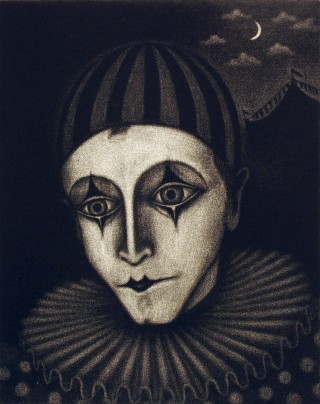
As a non-Western student, Pierrot is not an inherent part of my culture, and I knew nothing about him before I started this project, not even how he looks. I must have seen the mask before, but I cannot associate it with Pierrot, since no one told me about it, and I didn't happen to read about it.


This is a Pierrot artwork by Toru Iwaya in 1976.
He is white-faced, and the only character in commedia dell'arte without a mask. The commedia is an improvisatory theater that started in Italy in the 16th century. He is one of the zanni, humorous character. Usually in a family troupe, the youngest son who sleeps in the straws with the animals takes up the role of Pedrolino (Pierrot in Italian.) Despite having no political power in most personal relationships, and suffering from unrequited love, he "never loses his dignity". (quoting John Rudlin) He is only a fringe character.


It spread to France and the German states, died out in the late 18th century (not totally sure) as throughly-written theater was preferred over improvisatory ones. (Didn't that happen to music as well?) It enjoyed a new life from the 19th century on, thanks to the famous actor Deburau. He also brought Pierrot into the central stage. Schumann's Carnaval has a movement for Pierrot (1834-35):


The commedia characters are frequent in carnivals in France, Germany, and Austria. That sounds kinda cute, but Pierrot began to symbolize anxiety and the uncanny in at the end of the 19th century. 
If you don't know the Pierrot traditional tune, listen to this. It's one of the cutest children's songs.


It also began to be associated with the moon. Look at the right top corner of Toru Iwaya's picture above. You can also sense sadness, loneliness/alienation.


And someone added drunkenness to it. Albert Giraud wrote 50 rondel burgamesque poems on Pierrot lunaire (usually translated as Moondrunk Pierrot, but in fact the content, not the French title, suggest "drunkenness". lunaire means "of the moon" (adjective)). Otto Erich Hartleben artfully translated/ adapted all into German. Schoenberg picked 21 and wrote some music. Ugly music. But that's how history is written. Ugly music, finally, is recognized as music.
Pierrot is a character. He may or may not look ugly. But is his surroundings full of ugliness? Let me end with a section from Baudelaire's poem Le Cygne.


"I saw a swan that had escaped from his cage,
That stroked the dry pavement with his webbed feet
And dragged his white plumage over the uneven ground.
Beside a dry gutter the bird opened his beak,

Restlessly bathed his wings in the dust
And cried, homesick for his fair native lake:
"Rain, when will you fall? Thunder, when will you roll?"
I see that hapless bird, that strange and fatal myth,

Toward the sky at times, like the man in Ovid,
Toward the ironic, cruelly blue sky,
Stretch his avid head upon his quivering neck,
As if he were reproaching God!

Paris changes! but naught in my melancholy
Has stirred! New palaces, scaffolding, blocks of stone,
Old quarters, all become for me an allegory,
And my dear memories are heavier than rocks."

You can say... this is French problem, not German! Oh well... there is a similar sensibility, and there are local differences, too. That's what I wrote about in my paper.
But don't you think it's awesome that the collection of Baudelaire poem is called Fleurs du mal? That's everything in one small, small image. Intensely emotional title. Think of it, perhaps as a black-and-white pocket-size photo (there is a better, cooler, more professional word for "pocket-size photo"... darn, ESL...)
The complete poem, in French and English translation is available here.

Saturday, November 26, 2011

Let's not let it stale; FTM vs AMS

And that's why I write now.
Happy thanksgiving.

The past month, as you can guess, has been hectic. I would say I accomplished quite a lot and experienced a lot. I think I grew at least a little.

Let me outline some similarities and differences between the FTM and the AMS:
1. It's easier to correlate contents and theories across sessions in FTM. In the AMS, topics are totally different across the wall.
2. It's easier to socialize at FTM, whereas in AMS, you feel like everyone has known one another, and the newbie easily gets lost.
3. However, in some cases, it is easier to meet people at the AMS. There is a large book exhibit where people hang around when they're not sitting in sessions. People there are free to talk to.
4. In both conferences there are good and bad papers.
5. The variety in AMS is stunning. It's really good for me to browse different areas of research, including music and philosophy, western colonial music, keyboard music, feminist theory, Beethoven, etc.
6. There is no keynote speech in AMS.
7. There is no free coffee in the morning in AMS.
8. There is a buddy program in AMS, where a senior become a mentor for a first or second time AMS attendant. Last year, my friend said his mentor never showed up. This year, we shared a very kind-hearted mentor, assistant professor for Belmont University.
9. FTM papers can be more extreme and exciting. I can never imagine Elizabeth Gould's paper on lesbian performativity in Joan Sutherland's and Marilyn Horne's "Flower Duet" can appear in AMS. But gosh, that's a provocative paper!
10. There are junior papers in FTM. In AMS, papers are more mature.
11. There are independent scholars as well as scholars from Germany in the FTM. In AMS, there are a few from UK, and one from Taiwan.
12. FTM has a more contemporary interest than AMS. The repertoire on contemporary music is much larger in the form, ranging from Johanna Beyer to Diamanda Gallas and Bitch. There are also much more interest in fringe artist-musicians.
13. In a way, the selection in FTM forces me to know different kinds of music, which is very good. That includes different kind of pop and American music. In AMS, I'll just go to European and Asian-western music sessions.
14. FTM has a few non-music scholars, from literature and sociology departments. In AMS, there is a one from history department, but she always hangs around at Eastman, as far as I know...
15. Susan McClary is in both.
16. Richard Taruskin argued with a speaker in the AMS, an exciting scenario that I barely missed!!!
17. There is a cute mom and cute baby in the FTM. No babies in AMS.

Wednesday, October 26, 2011

Music, and Critique to Critiques to "Occupy Wall Street"

Let's start with some music: this is what a social movement could sound like.


There are a few quick points that I'd like to make.
1. One may say this piece of music is so happy. Try to think in the following ways: a) look at the freedom and equality of the musical elements, and how everything work together. Isn't this a reflection of an ideal society? And that's why people are enjoying this music. b) matching this positive, major key music, with a bitter 1% versus 99% world, isn't it ironic? Doesn't the movement also symbolize a postmodern, late capitalist irony?

2. Some critics said the movement lacks a clear goal, and therefore could not succeed after a quick boom in the press. I think, If the movement fails, it is not because of a lack of clear goal. If the movement succeeds, the fact that it doesn't have a clear goal plays a big role. Take these into account:
a) there are some people who are just suffering and have no idea how to get out of the vicious loop of suffering. They have their own problems. (Like the PhD who has no jobs, I think that guy doesn't represent the general PhD population!) They lack a clear goal, but would you say they shall stay home, surf the internet in the library to find jobs, instead of coming out to protest? The answer depends on whether you are a conservative or a neo-Marxist democrat who thinks that change has to be enacted in a new way.
b) There a lot of people in the movement who have ideas and plans. (To people questioning this: Zizek don't have an idea? I don't think so.) But they do not enforce it on others in order to formulate an "Occupy Wall Street Manifesto" or something akin. They were the people who have been subsumed under undesired categories, and they would not want to subsume others. In fact this is the core question of post-coloniality, and there are interesting resemblances here. It is the job of the government to negotiate between different power systems, and they are endorsed to do so by various elections. (which does not happen in Hong Kong, very unfortunately).

One thing I found out (actually stole from my professor's talking) is that looking at UK media does give a different picture of the event.
http://www.guardian.co.uk/world/2011/oct/25/egyptian-protesters-occupy-wall-street
http://www.guardian.co.uk/commentisfree/cifamerica/2011/oct/27/occupy-oakland-not-beaten
Another thing that I really appreciate is the political ethics that I found.
http://communities.washingtontimes.com/neighborhood/tygrrrr-express/2011/oct/26/how-occupy-wall-street-protesters-destroy-working-/
In this final article, the author explicitly states that he is a "politically conservative columnist". He states his standpoint so clearly, and implicitly tells you there are alternatives to look at this issue. In the columns in Hong Kong and China, some authors are ambivalent about this. Or, maybe they just want to tell the readers that this is the right way to look at the issue, and, if you still have a free and open mind,  that is politically unethical.

Tuesday, October 18, 2011

Eagleton's Strategies; Why does the world need music scholars


This time, I analyze the strategies that Terry Eagleton uses in his “What is Ideology?” Ch. 1 in Ideology: an introduction. (London: Verso, 1991), and try to make an argument on a musical belief of mine.

Eagleton’s essay includes daily-life examples, deploys both “firm” and “flexible” propositions, and has a strategic organization in its argument. Daily-life examples ground the abstract term “ideology” in physical manifestations, and also prove the relevance of “ideology” to the reader. For instance,
“What, then, would be meant if somebody remarked in the course of a pub conversation: ‘Oh, that’s just ideological!’” (p. 3)
“Soviet Union is in the grip of ideology while the United States sees things as they really are.” (p. 4)
“Firm” propositions establish an authoritative image of the author, while “flexible” ones create space for the reader to further analyze the subject matter and make his/her own stand. By flexibly opening up a variety of possibilities in defining “ideology”, Eagleton also avoids counter-examples that may attack a narrower definition of the term. For instance,
            Firm: “There is no reason to believe in a post-Freudian era that our lived  experience need be any less ambiguous than our ideas.” (p. 20)
            Flexible: “What side you take up in this debate depends on whether or notyou are a moral realist.” (p. 17)
The essay, dealing with the complicated concept of “ideology,” is made coherent by a tactical narrative structure. Eagleton starts with random definitions of ideology, then goes on to analyze their individual connotations, as well as their mutual compatibility, contradictions, and implications. This leads to the central discussion on the politics of “ideology.” Before the conclusion section, the author prompts the nearing of argument’s closure by mentioning “the cynics,” a term closely related to the postmodernists that he rejects at an earlier part of the essay (precisely, in the “individual connotation” part I mentioned above). The end echoes the beginning by proposing different possibilities of “ideology,” this time in a much more organized manner.

Now, it’s my turn. Warning: this is no a scholarly essay.


The title is “Why does the world need music scholars?”
The global financial crisis worsens. Educational budgets are cut, and the Arts appear vulnerable because of their lack of financial productivity. It seems that the chemical-pharmaceutical PhDs who invent drugs, or the international relations MAs who work in the United Nations, or the BBAs who did internships at i-banks are more socially and financially relevant than aspiring music scholars.  Many of my friends, non-musicians, politely expressed their astonishment when I told them “I’m doing a PhD in music.” For sure, people like me have strong feelings toward our undertakings, but it is also fair to say that musical scholarship is hermetic in the public eye. How shall we present ourselves to others? Let me name some more or less random ideas:
(a) we write music history;
(b) we write music histories;
(c)  we narrate music verbally, supported by formal analyses on top of personal feelings;
(d) we judge and criticize music;
(e) we discover things that will change the current history textbook;
(f)  we produce critical scores for performers to play with, hence play an important part in delivering the composers’ intent to the audience;
(g) we observe and analyze sounds, silences and noises that may otherwise go unnoticed;
(h) we change people’s (musicians or non-musicians) perspectives on music;
(i)   we tell untold stories about music and musicians;
(j)   we tell existing stories from new perspectives;
(k) we speak for the dead and the repressed.
So on, and so forth. Some interesting observations come up. First, some situations can be described by more than one of these formulations. For instance, new research may tell untold stories of Beethoven (a dead person) and hence revise music history. Second, none of these formulations inhibit one another and this implies a liberty and variety in what music scholars can do. (a) and (b) exhibit ontological or presentational differences. One can use different kinds of formal analyses to repute or reconfirm existing beliefs. Third, some of these formulations have ambiguous boundaries with other disciplines, such as music critic and performing musicians. Fourth, all of the above are related to society, directly or indirectly. Hence, I suggest a few ways in presenting the music scholar’s social relevance.
Some of our work create new methods of appreciating music. They act as the mediator/ alienator between the public and the musician. They may also provide analytical tools to the sociologists and critical analysts. This category also includes people who strive for the most accurate representation of music and musicians.
            Some scholars look at how music functions in society from different angles. They reveal, for instance, representations of violence in classical masterpieces, and also speak for people/ musicians who are misrepresented by popular journalism and social thoughts. 
            And I must acknowledge music scholars who do basic research. As Jann Pasler phrases in the Critical Studies Seminar yesterday, "utility may not be circumscribed by people around the original finding". Some academic essays may seem  to lack utility or social implication at the moment they are presented and published. Nonetheless, we shall celebrate basic research just as the Nobel prize emphatically celebrates so, and not neglect its potential contributions.
            An action music scholar voices their social concerns loudly to the public. Leo Treitler wrote about the Gulf War on New York Times. Taruskin had his say on Boston Opera’s cancellation of Kinghoffer after 9-11. Similar efforts were made by, for example, Hon-Lun Yang in exploring the censored music in China, and Susan Cusick in writing on musical abuse by the American Army in Afghanistan. The lack of publicity, however, hindered the spread of their messages. (Cusick’s article only made it to the newspaper through Alex Ross’s column, and not many lines were devoted to it.) The most direct societal interaction is physical involvement, to have a music scholar deliver a speech or perform in public. Right now, I can think of non-music scholars such as Coco Fusco and Zizek (in his exciting speech in Occupy Wall Street).
After all, as a music scholar, we are not going to save the financial crisis (and, by the way, who can do that now?) We have different endeavors, meaningful ideals. Aspiring scholars, I contend, shall actively explain the value of musical scholarship to others in society. And don’t forget, the life of a scholar is far more than life as a scholar.